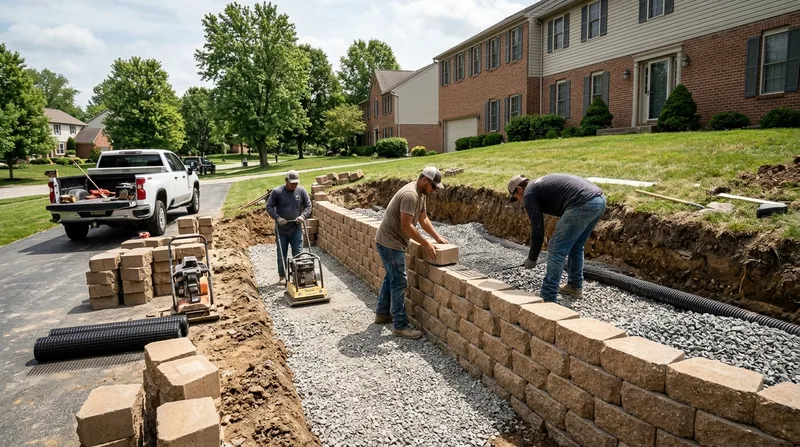




Block & Segmental Retaining Walls in Columbus solve the freeze-thaw and clay-till problems that plague central Ohio yards. From the ravine lots of Upper Arlington to the newer subdivisions spreading across Westerville and Powell, segmental block systems offer a durable, flexible alternative to failing timber walls and cracking poured concrete. Columbus sits on dense, slow-draining glacial till cut by the Scioto and Olentangy rivers, with spring rains and winter frost heave pushing old walls out of line. Segmental retaining walls in Allan Block, Versa-Lok, and Keystone systems use mortarless engineered blocks and geogrid reinforcement to handle that movement, hold slopes, and create clean terraces without the maintenance headache of railroad ties or the cracking risk of monolithic concrete. We install, repair, and replace these walls across Columbus and the surrounding area. Call us at (380) 800-5656 for a free estimate, or read on to understand why segmental block is the smart choice for your property.
Why Segmental Block Retaining Walls Matter in Columbus
Columbus homeowners face a unique challenge: the region's heavy clay till, shallow limestone, and seasonal freeze-thaw cycles destroy old walls. Timber and railroad tie walls from the 1970s and 1980s rot, settle unevenly, and lean within 15 to 20 years. Poured concrete cracks as the ground shifts. Segmental block systems absorb that movement because each block sits independently, held in place by geogrid reinforcement buried in compacted backfill. The blocks can shift slightly without failure, and if one block does fail, you replace just that unit rather than rebuilding the entire wall.
- Mortarless construction allows each block to move with seasonal frost heave and clay expansion without cracking.
- Geogrid reinforcement ties the wall into the slope, preventing the catastrophic outward failure you see in old timber walls.
- Curved walls, tiered gardens, and complex terraces are achievable with segmental blocks in ways that rigid concrete cannot match.
- Maintenance is minimal: no staining, no rot, no chemical sealers needed every few years like timber.
- Segmental walls age gracefully and hold their appearance for 30 to 50 years with proper drainage and base preparation.
When your yard sits on a ravine lot in Clintonville or a sloped subdivision lot in Hilliard, a segmental block wall gives you the strength and flexibility to hold the slope without constant repair.
Key info: Columbus building departments typically require a permit for walls taller than 4 feet measured from the footing, or when the wall supports a surcharge such as a driveway or structure. Always verify local requirements with your city or township building department before breaking ground. Engineered drawings may be required for tall or tiered walls. Columbus Building & Zoning Services can confirm thresholds and setback rules for your property.
How We Install Block & Segmental Retaining Walls in Columbus
Our process starts with a site assessment to understand slope angle, soil type, drainage, and load. We identify what water is doing to the slope now and where it will go after the wall is in place. Poor drainage is the number-one cause of wall failure in Columbus, so we size the drainage blanket, gravel backfill, and perforated pipe before we set the first block. We also verify setback requirements with the local building department and confirm whether your wall needs an engineered design.
- We excavate and level the footing area, compacting the base to remove soft spots and ensure the wall starts on solid ground.
- We lay the first course of block, checking level and alignment so the wall doesn't drift as we go higher.
- We install geogrid reinforcement between each course, extending it back into the slope according to the wall height and soil type.
- We backfill behind the geogrid with compacted gravel, creating a stable mass that the grid ties into the wall.
- We install a drainage blanket and perforated pipe at the base to collect and redirect groundwater away from the wall.
- We set each successive course of block, checking for plumb and level, until we reach the final height.
- We cap the wall with finished block or stone and grade the slope above to direct water away from the wall face.
A typical 3-foot tall block wall in a Dublin or Westerville backyard takes 3 to 5 days from start to finish. Larger, tiered systems or walls on steep ravine lots may take longer. We work within your schedule and keep the site clean.
Real example: A German Village homeowner had an old railroad tie wall leaning into her patio. We removed the ties, excavated the slope, set a 4-foot segmental block wall with full geogrid reinforcement and underdrain, and terraced the slope above with native plants. The wall is now straight, stable, and will hold for decades. See our retaining wall installation page for more project photos.
Methods and Materials
| Block System | Description | Best for |
|---|---|---|
| Allan Block | Interlocking tumbled-face blocks in neutral grey and earth tones, widely available in central Ohio, mortarless with integral lip. | Residential yards, terraces, and curved walls where appearance matters and budget is moderate. |
| Versa-Lok | Solid engineered blocks with multiple facing options, including decorative colors and finishes, mortarless with shear key. | High-visibility walls in Upper Arlington or Bexley where architectural appearance is critical. |
| Keystone | Modular block system with stepped-back design, available in segmental and solid options, engineered for tall walls. | Slopes steeper than 2:1, tall walls requiring engineered design, and ravine properties in Clintonville or Worthington. |
| Geogrid Reinforcement | Polypropylene or polyester grid laid horizontally between courses, extends back into backfill to create composite soil-grid mass. | All segmental walls taller than 2 feet, and mandatory for walls over 4 feet or supporting surcharge (driveway, structure). |
Block & Segmental Retaining Walls Cost in Columbus: What to Expect
Segmental block retaining wall installation in Columbus typically runs from $25 per square foot for a straightforward 3-foot wall on level ground with good access. That price assumes compacted clay backfill, standard geogrid, and a simple gravel underdrain. A 20-foot-long by 3-foot-tall wall would fall into the $1,500 to $2,000 range at that baseline.
Several factors push that number higher. If your slope is steep or the soil is weak, you need more geogrid and thicker reinforcement, which increases labor and material cost. If the wall is taller than 4 feet, you may need engineered drawings, which add $400 to $800. If the site is tight (narrow ravine lot, close to existing structures, trees in the way), mobilization and careful excavation take more time. If you're terracing a slope with multiple tiers, the per-foot cost rises because each tier requires its own footing, drainage, and reinforcement setup.
We recommend getting two to three estimates from licensed contractors in Columbus to compare scope, material choice, and timeline. A low bid that skips geogrid, uses thin backfill, or ignores drainage will fail within 5 to 10 years in Columbus' freeze-thaw climate. A high bid may include unnecessary engineering or premium materials you don't need. Our estimate is free and covers everything you need to make an informed decision. Call (380) 800-5656 or visit our full pricing page for detailed cost breakdowns by wall height and material.
Block & Segmental Retaining Walls Near Me: What Columbus Homeowners Should Know When Hiring
Choosing the right contractor for your block wall is as important as choosing the right blocks. A cheap install with poor drainage or inadequate geogrid will cost you thousands in repairs within a decade. When you call contractors in Columbus or nearby areas like Westerville, Upper Arlington, and Dublin, ask these questions to separate the professionals from the DIY-minded.
First, confirm that the contractor is licensed and insured for retaining wall work. Ohio requires contractors to register with the state, and most municipalities require a license to pull a permit. Ask for proof of liability insurance and workers' compensation. A reputable contractor will provide certificates without hesitation.
Second, ask whether the wall will need a permit and an engineered design. Many homeowners skip the permit to save money, but if your wall fails and damages a neighbor's property or causes erosion, you are liable. If your wall is taller than 4 feet or supports a driveway or structure, your local building department (Columbus, Dublin, Westerville, etc.) will require a permit and possibly engineered drawings. A contractor who brushes off the permit question is cutting corners.
Third, get references from recent jobs in Columbus or nearby. Ask to see photos of finished walls and contact previous customers. A mature segmental wall should look straight, well-capped, and drained. If you see walls that are tilted, cracked, or weeping water, that contractor is not managing drainage or compaction properly.
Finally, understand the timeline and warranty. A typical 3-foot wall takes 3 to 5 days. If a contractor promises to finish in one day, they are rushing the base preparation and compaction, which will cause failure. Ask what happens if the wall settles or a block cracks within the first year. A good contractor warrants the structural integrity of the wall for at least one year.
Ready to move forward? Contact us for a free estimate and we will walk you through the permitting process, material choices, and cost for your specific project.
Block & Segmental Retaining Walls in Columbus: Pricing Guide
| Service | Price | Details |
|---|---|---|
| Basic segmental block wall (3 feet tall, good access) | Starting at $25/sq ft | Includes excavation, base prep, geogrid, gravel backfill, underdrain, and finished cap on level or gently sloped ground |
| Tall or tiered wall (4 feet or higher, multiple tiers) | Starting at $35/sq ft | Requires engineered design, increased geogrid, thicker backfill, and additional site work; complexity and height drive cost upward |
| Difficult site (steep slope, tight access, trees, poor soil) | Starting at $40/sq ft | Includes careful excavation, soil stabilization, extra geogrid, and extended drainage; site conditions and access constraints increase labor |
| Engineered design and permit support | $400 to $800 | Required for walls over 4 feet or supporting surcharge; we coordinate with building department and provide contractor drawings |
| Travel and mobilization | Included | No extra charge for service calls and estimates within Columbus and surrounding areas like Dublin, Westerville, Upper Arlington, Hilliard |
| Free estimate | No obligation | Response within 24 hours at (380) 800-5656; we assess site, soil, slope, and drainage to give you a realistic range |
Indicative pricing, the exact cost depends on square footage, finish, and site access. Free personalized estimate within 24h at (380) 800-5656.


