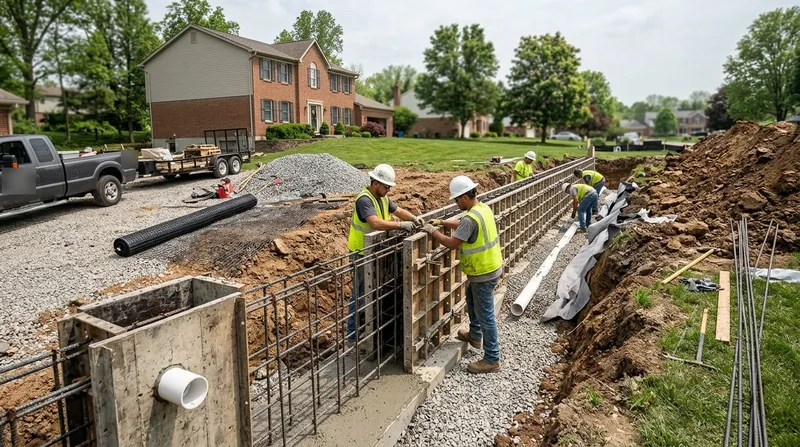




Concrete retaining walls in Columbus are the strongest, longest-lasting solution for holding back soil on steep lots, along driveways, and in the tight yards of our older neighborhoods. Columbus sits on dense glacial till clay that moves with freeze-thaw cycles and spring saturation, pushing weak walls outward and collapsing tired timber and railroad tie structures from the 1970s and 1980s. Poured concrete and reinforced CMU block walls, set on footings below frost depth with proper drainage and rebar, stop that movement cold. Whether you're stabilizing a ravine lot in Clintonville, protecting a driveway cut in German Village, or replacing a failed wall in Upper Arlington, a concrete retaining wall is engineered to last 50 years or more. We install, repair, and replace concrete walls across Columbus and the surrounding area, handling everything from design and permitting to final grading and drainage.
Why Concrete Retaining Walls Matter in Columbus's Challenging Soil and Climate
Columbus homeowners face a specific problem: our clay-heavy soil and freeze-thaw cycles push out walls that aren't engineered properly. Winter frost heave lifts soil and cracks weak mortar. Spring rains saturate the till and create hydrostatic pressure behind walls. Older timber and stacked stone walls fail because they lack footings, drainage, and reinforcement. Concrete walls, built to code with proper footings below the frost line (roughly 3 feet deep in Columbus), rebar, and weep holes, resist all three failure modes at once.
- We pour concrete walls with footings set below frost depth to prevent heave and settlement.
- We install weep holes and backfill drainage to release water pressure and stop hydrostatic failure.
- We use reinforcing rebar in both poured concrete and CMU block walls to handle tension and bending from soil load.
- We design and obtain permits for walls above 4 feet or those supporting a surcharge like a driveway, working with your local building department to meet setback and property-line rules.
- We grade and slope the top of the wall to shed water away from the structure and prevent pooling.
These details separate a wall that lasts decades from one that fails in five years.
Local insight: A homeowner in Worthington with a 6-foot wall supporting a new deck discovered their old stacked limestone wall was moving outward at 2 inches per year. We removed it, poured a reinforced concrete wall with proper drainage, and the deck now sits on solid ground. That wall will not move again.
For more on the specific repairs we handle for walls that are already in trouble, see our leaning and collapsed wall repair service. The Columbus Building and Zoning Department website lists permit thresholds for your neighborhood at columbus.gov/building.
How We Build Concrete Retaining Walls in Columbus: Our Process
Every concrete wall job starts with a site visit and soil assessment. We measure the height, slope, and load on the wall, check for underground utilities, and verify setback and easement rules with the local building department. From there, we design the wall, obtain permits if required, and move to construction. The work is systematic: we excavate the foundation trench, set footings below frost depth, place and tie rebar, pour or build the wall, install drainage, and backfill with compacted soil.
- We excavate the foundation trench to frost depth (typically 36 to 42 inches in Columbus) and compact the base to prevent settlement.
- We set concrete footings that extend below the frost line and provide a stable bearing surface for the wall.
- We place and tie reinforcing rebar in a grid pattern to resist bending and tension from soil pressure.
- We pour concrete or build CMU block walls in lifts, using proper concrete mix design and consolidation to avoid voids and weak spots.
- We install weep holes or a perforated drain pipe behind the wall to release water and prevent hydrostatic pressure buildup.
- We backfill with compacted, free-draining material and slope the grade away from the wall to shed surface water.
The entire process takes longer than a timber or stone wall because we do it right, but the result is a wall that stands for 50 years without maintenance.
Real example: A homeowner in Dublin needed a 5-foot wall to cut a level building pad from a steep ravine lot. We designed a reinforced concrete wall, obtained the permit from Dublin city planning (which required engineered drawings), excavated 4 feet to frost depth, poured the wall in two lifts over a week, and installed perforated drain pipe behind it. The wall has now held for eight years without movement or cracking.
For more on retaining wall installation in your area, contact us for a free estimate.
Concrete Retaining Wall Methods and Materials
| Approach | Description | Best for |
|---|---|---|
| Poured Concrete | Monolithic concrete wall poured into forms with embedded rebar and weep holes. Typically 8 to 12 inches thick. | Tall walls, tight spaces, high-load applications, and driveways. Most common in Columbus for walls above 4 feet. |
| Reinforced CMU Block | Concrete masonry unit (CMU) blocks stacked and grouted with vertical and horizontal rebar. Typically 8 to 12 inches wide. | Moderate walls, areas where poured concrete is difficult, and where a block face is preferred for appearance. |
| Segmental Block (SRW) | Interlocking manufactured blocks with geogrid reinforcement. Faster to build and easier to adjust for slope or irregular sites. | Shorter walls (up to 4 feet), landscaped yards, and newer subdivisions. Less common for tall load-bearing walls in Columbus. |
| Hybrid (Concrete Base + Block Face) | Poured concrete core with CMU or decorative block veneer on the face. Combines strength and appearance. | High-visibility locations, architectural neighborhoods like German Village and Victorian Village, and premium finishes. |
Concrete Retaining Walls Cost in Columbus: What to Expect
Concrete retaining walls in Columbus start at $35 per square foot for a straightforward poured concrete wall in good soil with good access. A 4-foot wall running 30 feet long (120 square feet of face) would cost roughly $4,200 to $5,400 before permitting or site prep. That price moves up if the wall is taller, if soil is poor and requires special footings, if access is tight (narrow driveway, trees, utilities), or if you need engineered drawings for a tall or tiered wall. Permitting fees vary by city but typically add $200 to $800 for walls above 4 feet.
Several factors drive the final cost. The height and length of the wall are the primary drivers, since every foot of height and every foot of length adds material and labor. Soil conditions matter: dense clay till is easier to excavate than bedrock or shallow limestone, but poor drainage or weak bearing soil may require deeper footings or additional reinforcement. Access and site prep also affect the price: a wall in a ravine lot with mature trees and no driveway access will cost more than one on open ground. Whether you need an engineered design (required in many Columbus neighborhoods for walls above 4 feet or supporting a surcharge) adds $500 to $1,500 to the project cost.
We recommend getting two or three estimates before you commit. Each contractor may see the site differently, and comparing estimates helps you understand what is and is not included. For a detailed breakdown of our pricing and examples of recent projects, visit our pricing page. Call us at (380) 800-5656 for a free, no-obligation estimate.
Concrete Retaining Walls Near Me: What to Look for When Hiring a Contractor in Columbus
Finding the right contractor for a concrete retaining wall is about more than price. You need someone who understands Columbus soil, frost depth, and permitting, and who has the equipment and crew to do the work safely and to code. Start by verifying that the contractor is licensed and insured in Ohio. A valid general contractor or masonry license shows they have passed a trade exam and carry liability and workers' compensation insurance. Ask for proof of insurance and a certificate of good standing from the Ohio Construction Industry Licensing Board. Second, get multiple estimates and ask each contractor how they handle drainage, frost depth, and permitting. A good contractor will explain why they are designing the wall a certain way, not just give you a number. Third, check references: call past clients and ask if the wall is still standing, if there are any cracks or leaks, and if the contractor was professional and on time.
Permitting is also a contractor responsibility. In Columbus, Dublin, Upper Arlington, Westerville, and other cities in our service area, walls above 4 feet or supporting a driveway typically require a permit and may require engineered drawings. A contractor who skips permitting to save money is exposing you to liability and fines. Ask your contractor to walk you through the permit process and provide a timeline. Finally, check whether your HOA has rules about wall height, material, or design. Many neighborhoods in Upper Arlington, New Albany, and Hilliard restrict retaining walls to certain styles or heights. Your contractor should ask about this before quoting.
When you are ready to move forward, contact us for a free estimate. We will visit your site, discuss your goals, explain our process, and provide a detailed quote with no obligation to book.
Concrete Retaining Walls in Columbus: Pricing Guide
| Service | Price | Details |
|---|---|---|
| Poured Concrete Wall (standard) | Starting at $35/sq ft | Includes excavation, footings, rebar, concrete, weep holes, and backfill for straightforward sites with good access |
| Reinforced CMU Block Wall | Starting at $38/sq ft | Stacked and grouted concrete blocks with vertical rebar, weep holes, and drainage. Slightly higher labor than poured concrete |
| Engineered Design and Permitting | $500 to $1,500 | Required for walls above 4 feet or supporting a surcharge. Includes structural drawings and permit application and fees |
| Difficult Site or Poor Soil | On estimate | Bedrock excavation, shallow limestone, poor drainage, or tight access require site-specific design and additional labor |
| Travel and Mobilization | Included | No mileage fee or travel charge within Columbus and surrounding service areas. Included in the project estimate |
| Free Estimate | Free | Site visit, soil assessment, design discussion, and written quote with no obligation. Response within 24 hours |
Indicative pricing, the exact cost depends on square footage, finish, and site access. Free personalized estimate within 24h at (380) 800-5656.


