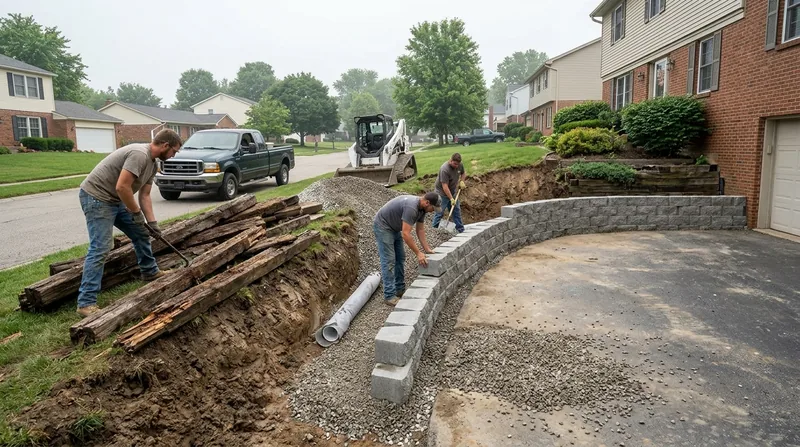




Railroad Tie Wall Replacement in Columbus is one of the most common retaining wall jobs we handle across the city and its suburbs. Thousands of homes built in the 1970s and 1980s across Upper Arlington, Westerville, Dublin, and Columbus proper have railroad tie walls that are now failing, rotting, or leaning dangerously outward. The combination of Columbus's dense clay till soil, freeze-thaw cycles, and the natural breakdown of creosote-treated wood means these walls rarely last more than 30 to 40 years. When a railroad tie wall starts to fail, water pooling behind it, ties splitting or separating, or the whole wall tilting toward your yard, replacement becomes both a safety issue and a property value concern. We remove the old ties, haul away the creosote debris responsibly, install proper drainage and gravel backfill, and rebuild with durable block, concrete, or stone that will hold for decades.
Why Railroad Tie Wall Replacement Matters in Columbus's Aging Suburbs
Columbus's residential landscape includes thousands of 1970s and 1980s homes built on slopes and ravine lots where landscape timber and railroad tie walls were the standard choice. The Scioto River valley, wooded ravines like Glen Echo and Walhalla in Clintonville, and the gently rolling glacial till plains mean that backyard terraces and slope retention are facts of life here. Over four decades, freeze-thaw stress, spring runoff soaking through clay till, and the natural decay of creosote-treated wood have left many of these walls unstable, leaning, or actively crumbling. A failing railroad tie wall doesn't just look bad, it allows erosion, threatens foundations or driveways, and can collapse suddenly if not addressed.
- We excavate and remove all rotted, splintered, or leaning railroad ties without leaving creosote-contaminated debris on your property.
- We install a proper gravel backfill and drainage layer to prevent the water pressure that destroyed the original wall.
- We rebuild with segmental block, poured concrete, or stacked limestone that handles Columbus's wet springs and freeze cycles.
- We verify setbacks and property lines, and we handle permitting coordination with your local building department.
Replacing a failed railroad tie wall stops erosion, protects your yard and neighboring properties, and restores the structural integrity of your slope.
Key info: Columbus and many suburban jurisdictions require a permit for retaining walls taller than 4 feet or walls that support a surcharge (driveway, deck, structure). Always verify with your local building department before starting work. See the City of Columbus Building & Zoning Services or your suburb's permit office for exact thresholds.
How We Replace Railroad Tie Walls in Columbus: Step-by-Step Process
Railroad tie wall replacement is not a quick patch job. We start with a site inspection to assess the wall height, soil conditions, drainage, and what's behind or above the wall. We then plan the demolition, removal, and rebuild so that your yard stays stable and the new wall is engineered to last. In neighborhoods like German Village, Victorian Village, and Upper Arlington, we work carefully around mature trees, foundation plantings, and existing utilities.
- We mark the wall perimeter, protect adjacent plants and structures, and plan equipment access.
- We excavate to proper footing depth, set a compacted gravel base, and install perforated drainage pipe behind the new wall line.
- We backfill with clean gravel and fabric to promote drainage away from the new wall structure.
- We rebuild the wall using segmental block, poured concrete, or stacked stone, depending on your site, budget, and aesthetic preference.
- We grade and finish the top surface, and we restore landscaping or mulch as needed.
The entire process typically takes 3 to 7 days depending on wall length, height, and the complexity of the site.
Example: A 40-foot-long, 3-foot-tall railroad tie wall in a Worthington backyard with dense clay and poor drainage took us 5 days to remove, prep, and rebuild in segmental block. The homeowner avoided a catastrophic collapse and gained a 50-year wall that handles spring snowmelt without issue.
If you are unsure whether your wall needs full replacement or just repair, we offer a retaining wall repair service for walls that are still structurally sound but have isolated damage or minor leaning.
Replacement Materials: Block, Concrete, or Stone
| Material | Description | Best For |
|---|---|---|
| Segmental Retaining Wall Block | Interlocking engineered blocks, often with a textured or split-face finish, designed for residential slopes and terraces. | Most common choice in Columbus suburbs; easy to tier, clean lines, 40-50 year lifespan, minimal maintenance. |
| Poured Concrete | Cast-in-place reinforced concrete wall, monolithic and very strong, can be finished smooth or with a broom texture. | Tall or heavily loaded walls, steep slopes, sites with limited space for block installation or tiering. |
| Stacked Ohio Limestone or Natural Stone | Dry-stacked or mortared local limestone and fieldstone, mimics historic Columbus walls and blends with older neighborhoods. | German Village, Victorian Village, and other historic districts where original stone walls set the aesthetic standard. |
| Boulder or Boulders | Large natural boulders stacked and mortared for a rustic, landscaped appearance, often combined with plantings. | Low to medium walls, natural-looking slopes, yards where a more organic aesthetic is preferred over engineered block. |
Railroad Tie Wall Replacement Cost in Columbus: What to Expect
Railroad tie wall replacement in Columbus typically starts at $35 per square foot of wall face for a standard segmental block rebuild on a straightforward site. A 40-foot wall that is 3 feet tall would be roughly 120 square feet of face, putting the base cost around $4,200 to $4,800 before site-specific factors. The final price depends on wall height, total length, soil conditions, drainage requirements, the material you choose, and how much old concrete or debris must be removed before the new wall begins.
Factors that increase cost include poor drainage or groundwater, very steep or unstable slopes, proximity to utilities or structures, difficult equipment access, and the need for engineered drawings or permits. A full pricing overview breaks down material costs, labor, and site variables. We always recommend getting 2 to 3 estimates so you understand what is included at each price point and why costs may differ between contractors.
The best way to get an accurate number for your wall is to contact us for a free, no-obligation site visit. We measure the wall, assess drainage and soil, discuss material options, and provide a detailed written estimate within 24 hours.
Railroad Tie Wall Replacement Near Me: What to Look for When Hiring a Contractor in Columbus
Choosing the right contractor for railroad tie wall replacement is about more than price. You need someone who understands Columbus's clay soil, freeze-thaw cycles, and local permitting rules, and who will stand behind the work. Before you hire, verify licensing and insurance, check references from recent jobs, and ask whether the contractor handles permitting or expects you to pull the permit yourself.
- Ask for references from at least three recent wall replacement or repair projects in Columbus or nearby suburbs.
- Understand who handles the permit application and whether the cost is included in the estimate or added separately.
- Get the estimate in writing, including material type, wall dimensions, backfill and drainage specifications, and a timeline.
- Check whether the contractor offers a warranty on the new wall structure and for how long.
A reputable contractor will answer these questions clearly and provide references you can actually call. If a contractor rushes you, avoids discussing permitting, or quotes a price that seems too low, keep looking.
Ready to get started? Contact us today for a free estimate, or call (380) 800-5656. We serve Columbus and all surrounding areas, and we respond within 24 hours.
Railroad Tie Wall Replacement in Columbus: Pricing Guide
| Service | Price | Details |
|---|---|---|
| Segmental Block Wall Replacement | Starting at $35/sq ft | Includes demolition, gravel base, drainage, and new block wall; cost rises with wall height and site complexity |
| Poured Concrete Wall Replacement | Starting at $45/sq ft | Engineered reinforced concrete, formwork, and finishing; steeper or taller walls may require structural design and higher cost |
| Stone or Boulder Wall Replacement | Starting at $40/sq ft | Natural stone or boulder stacking, mortaring, and finishing; material availability and transport affect final price |
| Complex or Large-Scale Replacement | On estimate | Walls over 6 feet, poor drainage, utility conflicts, or engineered design requirements need a site visit and detailed proposal |
| Permitting and Design | Included or separate | Many jobs include permit coordination; complex walls may require engineered drawings, which we coordinate with your local building department |
| Free Estimate | No obligation | Site visit, measurement, and written proposal within 24 hours; call (380) 800-5656 to schedule |
Indicative pricing, the exact cost depends on square footage, finish, and site access. Free personalized estimate within 24h at (380) 800-5656.


