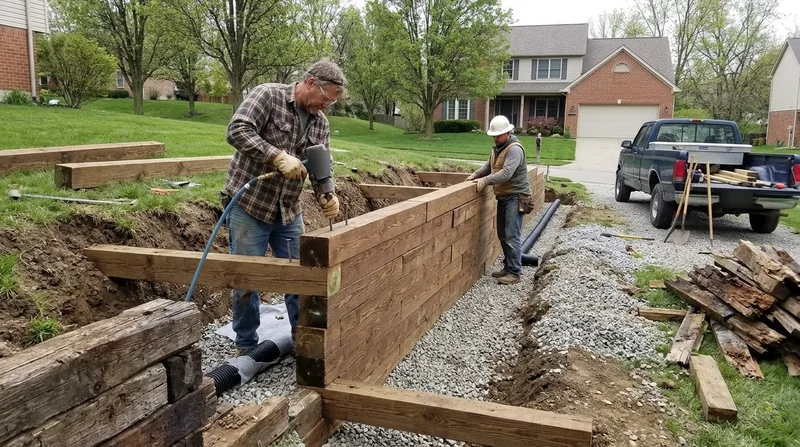




Timber Retaining Walls in Columbus offer a budget-friendly, approachable way to terrace garden beds, create low landscape barriers, and hold back soil on gentle slopes across our city's ravine lots and post-war neighborhoods. From the 1920s Tudors on wooded ravine properties in Clintonville and Upper Arlington to the newer subdivisions in Dublin and Westerville, Columbus homeowners have relied on pressure-treated timber walls to manage the flat-to-rolling glacial till terrain carved by the Scioto, Olentangy, and Alum Creek valleys. However, our dense, slow-draining clay soil, freeze-thaw cycles, and heavy spring rains create real challenges for timber: frost heave pushes walls outward, moisture rots untreated wood, and many older timber and railroad tie walls installed in the 1970s and 1980s are now failing. We help homeowners understand when timber makes sense as a temporary or garden-scale solution, and when a longer-lasting material like segmental block, poured concrete, or stone becomes the smarter investment. If you have a leaning or deteriorating timber wall, leaning and collapsed wall repair is often the first step.
Why Timber Retaining Walls Matter in Columbus: Climate and Soil Reality
Columbus sits on slow-draining glacial till with a shallow limestone bedrock, and our winters bring freeze-thaw cycles that crack and heave any wall foundation that isn't properly drained. Spring rains soak into the clay, hydrostatic pressure builds behind the wall, and frost expansion in January and February can push even a well-built timber structure 2 to 4 inches out of plumb in a single season. Timber walls installed without adequate drainage, without a proper gravel backfill layer, or with the footing set too shallow will fail faster in Columbus than in drier climates.
- We assess your soil drainage and frost depth before recommending timber versus a longer-lasting material.
- We install proper gravel backfill and perforated drain lines to reduce hydrostatic pressure and frost heave.
- We size timber posts and anchors for the weight and water load specific to Columbus clay soils.
- We identify when a failing timber wall should be replaced with segmental block retaining walls or concrete retaining walls for 20 to 30 years of life instead of 10 to 15.
Understanding Columbus soil behavior and seasonal water movement is the difference between a wall that lasts and one that fails before the warranty ends.
Local example: A 1960s brick ranch in Upper Arlington with a timber retaining wall holding back a sloped side yard had rotted posts and a 6-inch outward lean after 12 years of spring flooding. The original installer used untreated lumber and no drainage layer. We replaced it with pressure-treated posts, a 4-inch perforated drain line, and compacted gravel backfill, extending the wall's life another 15 to 20 years while we monitored the slope for long-term stability.
For more on how water and slope failure work together, see our retaining wall drainage page.
How We Install and Repair Timber Retaining Walls in Columbus
A properly built timber wall in Columbus starts with a frost-protected footing, pressure-treated lumber rated for ground contact, and a drainage system that keeps water from pooling behind the wall. We dig below the frost line (typically 30 to 36 inches in Columbus), set a compacted gravel base, and anchor the posts with concrete footings that resist frost heave. Backfill with clean gravel and a perforated drain line, and the wall will shed water instead of trapping it.
- We mark the wall line, check for utilities, and verify setbacks and property lines with your local building department.
- We excavate the footing trench below the frost line and compact a gravel base for drainage and stability.
- We set pressure-treated posts in concrete footings, ensuring they are plumb and properly spaced for the wall height and soil load.
- We install a perforated drain line behind the wall, wrapped in landscape fabric, and backfill with clean gravel to shed water.
- We cap the wall with pressure-treated lumber and check the final grade to confirm water drains away from the structure.
For a 20-foot wall 3 feet tall with proper drainage, the job typically takes 2 to 3 days from footing to finish.
Columbus example: A Victorian Village homeowner wanted to terrace a steep front garden bed. We installed a 15-foot timber wall, 2.5 feet tall, with a frost-protected footing and gravel drain line. The wall has held plumb for four seasons and is now the foundation for perennial plantings and a small sitting area. The key was the drainage: without it, the wall would have started leaning by year two.
If you have an older timber wall that is already leaning or showing rot, retaining wall repair may save it, or retaining wall replacement may be the better long-term choice.
Timber Retaining Wall Methods and Materials
| Approach | Description | Best for |
|---|---|---|
| Pressure-Treated 6x6 Posts with Gravel Backfill | Posts set in concrete footings below frost line, spaced 4 to 6 feet apart, with perforated drain line and clean gravel backfill. Rated for 10 to 20 years in Columbus clay soils with proper drainage. | Garden beds, low terraces, slopes under 2:1 grade, landscape transitions without building loads. |
| Timber Wall with Geogrid Reinforcement | Pressure-treated posts with layers of geogrid anchored back into compacted soil, adding internal stability for taller or steeper walls. Extends wall life and reduces outward lean on heavy clay. | Walls 3 to 4 feet tall, slopes steeper than 1.5:1, yards with limited setback space or heavy surcharge. |
| Timber Wall Repair and Re-anchoring | Straightening a leaning wall by installing new anchor posts, replacing rotted sections, adding new drainage, and reinforcing the footing without full demolition. Extends life 10 to 15 years if rot is caught early. | Existing walls with minor to moderate lean, local rot, or failed drainage. Not suitable if more than 40 percent of posts are compromised. |
| Full Timber Wall Replacement | Complete removal of failed timber or railroad tie wall and installation of new pressure-treated posts, footings, and drainage system. Opportunity to upgrade to concrete or block if timber is no longer the right choice. | Severely rotted or leaning walls, walls holding back driveways or structures, yards where long-term stability and low maintenance are priorities. |
Timber Retaining Walls Cost in Columbus: What to Expect
Timber retaining walls in Columbus start at approximately $20 to $30 per square foot for a straightforward installation with proper drainage. A 20-foot wall 3 feet tall (60 square feet) typically runs $1,200 to $1,800 before site conditions, soil removal, or material upgrades. The cost rises if your site has poor access, existing utilities to work around, heavy clay removal, or if we need to add geogrid reinforcement for a steeper slope or taller wall.
Three factors move the price up or down: first, the height and length of the wall (taller walls need deeper footings and larger posts); second, soil conditions and drainage complexity (dense clay with poor drainage requires more gravel and a longer drain line); and third, what you do with excavated soil (hauling it away costs more than regrading it nearby). Getting 2 to 3 estimates from licensed contractors in Columbus, Westerville, and Dublin will give you a clear picture of the local market and help you spot any low-ball bids that skip drainage or use untreated lumber.
Price reality: A 30-foot wall 2 feet tall in a Gahanna subdivision with good access and standard clay soil runs about $1,200 to $1,500. The same wall in a Clintonville ravine lot with rocky soil, tree roots to work around, and steep access drops to $2,000 to $2,500. Always get an on-site estimate before committing, because what looks simple from the street often hides complications below grade.
For detailed pricing across all our services and to compare timber against block, concrete, and stone options, visit our pricing page.
What to Look for When Hiring a Retaining Wall Contractor Near Columbus
A licensed, insured contractor in the Columbus area will carry general liability and workers compensation insurance, carry a valid contractor license from the state of Ohio, and be willing to pull permits for walls above 4 feet or walls supporting a driveway or structure. Many Columbus neighborhoods, including Upper Arlington, Dublin, and Worthington, have HOA rules or historic district guidelines that affect wall materials and placement, so ask your contractor to confirm local requirements before you break ground. Check references from at least two past jobs in Columbus or nearby suburbs, and ask specifically about drainage performance and how the wall has held up through two or three winters.
- We pull permits for all walls above 4 feet or walls supporting structures, and we work with your local building department to confirm frost depth, setback, and property line requirements.
- We provide written estimates that break down labor, materials, and any site-specific upgrades like drainage or geogrid reinforcement.
- We stand behind our work with a 5-year warranty on materials and workmanship, and we are available for post-installation adjustments if frost heave or settling occurs.
A contractor who rushes the estimate, skips the permit discussion, or quotes a price without seeing the site is likely to cut corners on drainage or footing depth, and you will pay for it when the wall leans in year two.
Call us at (380) 800-5656 or contact us online for a free, no-obligation estimate. We respond within 24 hours and we'll walk you through the entire process, including permitting and material choices.
Timber Retaining Walls in Columbus: Pricing Guide
| Service | Price | Details |
|---|---|---|
| Pressure-Treated Timber Wall, Standard Installation | Starting at $20/sq ft | Includes frost-protected footing, pressure-treated posts, gravel backfill, and perforated drain line. Price rises with wall height and soil complexity. |
| Timber Wall with Geogrid Reinforcement | Starting at $28/sq ft | Adds internal stability for taller or steeper walls in Columbus clay. Reduces frost heave and outward lean on slopes over 1.5:1 grade. |
| Timber Wall Repair and Re-anchoring | Starting at $15/sq ft | Straightens minor lean, replaces rotted sections, upgrades drainage. Extends wall life 10 to 15 years if rot is caught early and less than 40 percent of posts compromised. |
| Full Timber Wall Replacement | On estimate | Complete removal and new installation. Price depends on soil removal, debris hauling, and whether you upgrade to concrete or segmental block for long-term durability. |
| Travel and Site Visit | Included | No mileage fee for Columbus, Dublin, Westerville, Upper Arlington, Hilliard, Gahanna, Grove City, Reynoldsburg, Worthington, Bexley, Delaware, Pickerington, Powell, New Albany, Lancaster, and Newark. |
| Free Estimate | No charge | On-site evaluation, written quote, permit and material guidance. Response within 24 hours at (380) 800-5656. No obligation to book. |
Indicative pricing, the exact cost depends on square footage, finish, and site access. Free personalized estimate within 24h at (380) 800-5656.


