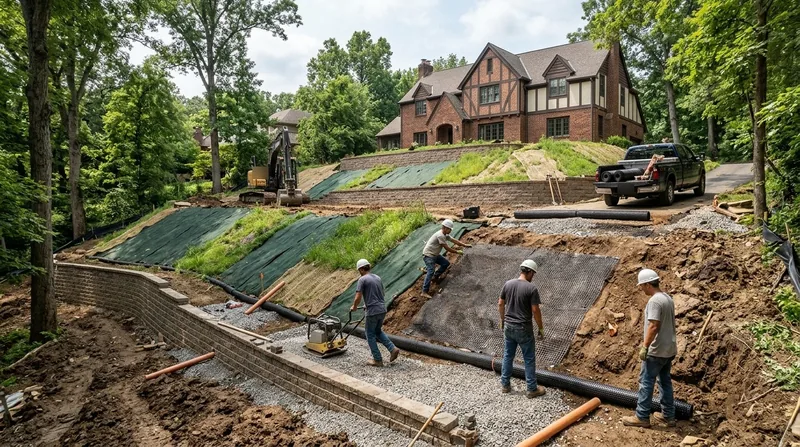




Columbus sits on glacial till plains carved by the Scioto and Olentangy rivers, with ravine lots and creek-bank properties scattered throughout neighborhoods from German Village to Powell. Homes perched on these sloped sites, especially 1920s Tudors in Upper Arlington and newer two-story builds in Westerville and Dublin, face constant pressure from freeze-thaw cycles, spring saturation, and slow-draining clay soil that destabilizes banks and yard slopes year-round. Slope stabilization and erosion control protects your foundation, driveway, and landscaping by anchoring soil with terraced retaining walls, geogrid reinforcement, and drainage systems designed for Columbus's wet, heavy-clay conditions. We install and repair these systems to stop active erosion, prevent foundation settlement, and reclaim usable yard space on properties where gravity and water are the daily enemy. Call us at (380) 800-5656 for a free site assessment, or learn more about our retaining wall installation services across central Ohio.
Why Slope Stabilization Matters in Columbus: Ravine Lots, Clay Soil, and Spring Flooding
Columbus's ravine and creek-adjacent properties drain poorly because the underlying glacial till is dense, sticky, and slow to absorb water. Every spring thaw and heavy rain soaks into the slope, adding weight and hydrostatic pressure that pushes soil outward and downward. Without proper terracing and drainage, yards slip, driveways crack, and home foundations settle unevenly. A failing slope can cost thousands in foundation repair, so catching erosion early and stabilizing it with engineered walls saves money and headaches.
- We install tiered retaining walls that break a steep slope into manageable steps, reducing shear stress on any single wall.
- Geogrid reinforcement anchors soil layers together, dramatically increasing the wall's resistance to sliding and settlement.
- Subsurface and surface drainage systems channel water away from the slope, lowering soil saturation and hydrostatic load.
- We stabilize creek banks and ravine edges using boulder or segmental block walls to prevent undercutting and collapse.
- Proper slope work protects driveways, patios, and utilities from cracking, heaving, and misalignment caused by soil movement.
Addressing slope instability before it becomes an emergency is the smart and cost-effective choice for any Columbus homeowner with a ravine lot or creek-side property.
Key info: Many Columbus neighborhoods like Clintonville, Bexley, and Upper Arlington have homes on wooded ravine lots where spring runoff and clay saturation cause slopes to fail. A two-tier wall system with geogrid and French drain can cost $4,500 to $12,000 depending on wall height, length, and access. The City of Columbus Building and Zoning Department requires a permit for walls over 4 feet from the footing, or when a wall supports a surcharge like a driveway. Always verify local setback and property-line rules before design begins. See Columbus.gov for current code requirements.
How We Stabilize Slopes and Control Erosion in Columbus
Our process starts with a site visit to assess slope angle, soil composition, drainage patterns, and any existing damage or movement. We then design a wall system (terraced block, poured concrete, or natural stone) sized to handle Columbus's clay-soil conditions and spring water load. Installation includes proper footing depth below the frost line (typically 3 to 4 feet in central Ohio), compacted base stone, geogrid layers between wall lifts, and a drainage system that channels water safely away from the slope and foundation.
- We excavate and level the footing to frost depth, ensuring the wall sits below the seasonal freeze-thaw zone.
- We place compacted granular base and install geogrid at specified intervals to reinforce and lock the soil mass.
- We set wall units (block, stone, or concrete) level and plumb, backfilling with proper drainage aggregate behind the wall.
- We install a perforated drain pipe and surface swale to intercept and divert groundwater and runoff away from the slope.
- We grade the top of the slope and establish erosion-control plantings or mulch to stabilize the surface and slow runoff.
This methodical approach stops active erosion and creates a stable, long-lasting slope that protects your home and yard for decades.
Example: A Westerville homeowner with a 25-foot-long ravine-edge slope that was sliding into a wooded creek had us install a 4-foot segmental block wall with two lifts of geogrid and a French drain system. The project took 4 days and cost $7,200. Two years later, the slope remains stable, the drain handles spring runoff without pooling, and the yard is usable again. This is typical for mid-sized slope jobs in the Columbus area. See our retaining wall drainage services for more on water management.
Slope Stabilization Methods: Choosing the Right System for Your Columbus Property
| Approach | Description | Best for |
|---|---|---|
| Segmental Block Walls with Geogrid | Modular concrete blocks stacked and locked with geogrid reinforcement between lifts. Highly flexible and easy to adjust for uneven terrain. | Multi-tier slopes, ravine edges, properties with limited access or complex shapes. Most common choice in Columbus subdivisions. |
| Poured Concrete Walls | Monolithic concrete wall with integral or external geogrid. Durable and uniform, with excellent load-bearing capacity and low maintenance. | Tall or heavily loaded slopes, driveway supports, and properties where appearance and longevity are priorities. |
| Boulder and Natural Stone Walls | Stacked Ohio limestone or boulders with soil-filled voids and geogrid. Blends with wooded and natural landscapes. | Ravine and creek-bank work, heritage properties, and homeowners seeking a natural aesthetic that matches surrounding forest and bedrock. |
| Timber and Railroad Tie Walls | Pressure-treated lumber or reclaimed railroad ties stacked horizontally and tied back with rebar or cables. Less common for new work due to rot and settling. | Replacement of existing failed timber walls, or low-height decorative terracing where budget is tight and maintenance is acceptable. |
Each method can be combined with geogrid, drainage, and proper footing design to meet Columbus's clay-soil and freeze-thaw challenges. We recommend segmental block or poured concrete for most slope-stabilization work because they offer the best balance of durability, cost, and repairability in central Ohio's climate.
Slope Stabilization and Erosion Control Cost in Columbus: What to Expect
Pricing for slope stabilization depends on wall height, length, soil conditions, drainage requirements, and site access. A simple single-tier wall 20 feet long and 3 feet high with basic drainage might run $2,500 to $4,000. A multi-tier system on a ravine lot with heavy geogrid reinforcement and a full French drain can easily reach $8,000 to $15,000 or more. We always start with a free estimate that includes a site walk, soil assessment, and a detailed proposal with material and labor costs broken down by phase.
- Wall height and length are the primary cost drivers; every additional foot of height or length adds material and labor.
- Geogrid reinforcement and multiple tiers increase cost but dramatically improve safety and longevity on unstable slopes.
- Drainage systems (French drains, perforated pipe, swales) add $800 to $2,500 depending on complexity and run length.
- Poor site access, dense tree cover, or rocky soil can increase excavation time and equipment costs by 20 to 40 percent.
- Permits and engineered drawings (required for walls over 4 feet in most Columbus jurisdictions) add $300 to $800 to the project cost.
We recommend getting two or three estimates from licensed contractors so you can compare scope, materials, and timelines. Visit our pricing page for typical cost ranges and examples, then call (380) 800-5656 to schedule your free on-site assessment. There is no obligation, and we respond within 24 hours.
Slope Stabilization and Erosion Control Near Me: What Columbus Homeowners Should Know When Hiring a Contractor
Finding a qualified contractor to handle slope stabilization in Columbus starts with verifying licensing and insurance. Ohio requires retaining wall contractors to be licensed as general contractors or specialty contractors, and proof of liability and workers' compensation insurance should be provided before any work begins. Ask for references from recent jobs in your neighborhood or similar terrain, and check online reviews for patterns of quality and timeliness. Many Columbus neighborhoods require permits for walls over 4 feet, and some HOAs (especially in Westerville, Dublin, and Upper Arlington) have architectural review boards that must approve designs before construction starts.
- Verify that your contractor holds a current Ohio general or specialty contractor license and provides copies of liability and workers' compensation insurance.
- Request three to five references from slope-stabilization or retaining wall projects completed in the past two years within Columbus or surrounding areas.
- Confirm whether your property requires a building permit by contacting your local city or township building department before design or construction begins.
- Review your HOA bylaws and architectural guidelines if applicable; some communities require pre-approval of wall materials, height, and placement.
- Ask about warranty coverage for the wall structure and drainage system, and get it in writing as part of the contract.
A professional contractor will walk you through the entire process, explain why certain methods are chosen for your soil and slope, and keep you informed throughout construction. Contact us today for a free consultation and to discuss your slope-stabilization needs with a field-experienced team.
Slope Stabilization & Erosion Control in Columbus: Pricing Guide
| Service | Price | Details |
|---|---|---|
| Free site assessment and estimate | Free | On-site soil and drainage evaluation, design review, and detailed proposal with material and labor costs broken down |
| Single-tier block or concrete wall, basic drainage | Starting at $2,500 | 3-foot wall up to 20 feet long with proper footing, geogrid, and basic surface drainage for small slopes |
| Multi-tier terraced wall with full French drain system | Starting at $6,500 | Two or more wall tiers, geogrid reinforcement, perforated subsurface drain, and surface swale for ravine and creek-bank properties |
| Large or complex slope project with engineering and permits | On estimate | Walls over 4 feet, surcharge loads like driveways, engineered drawings, and local building department permits require site-specific pricing |
| Travel and mobilization | Included | No separate call-out or mileage fee within Columbus and surrounding service areas including Dublin, Westerville, Upper Arlington, and Hilliard |
| Estimate response time | Within 24 hours | Free estimate with no obligation to book; call (380) 800-5656 or request online for fastest response |
Indicative pricing, the exact cost depends on square footage, finish, and site access. Free personalized estimate within 24h at (380) 800-5656.


