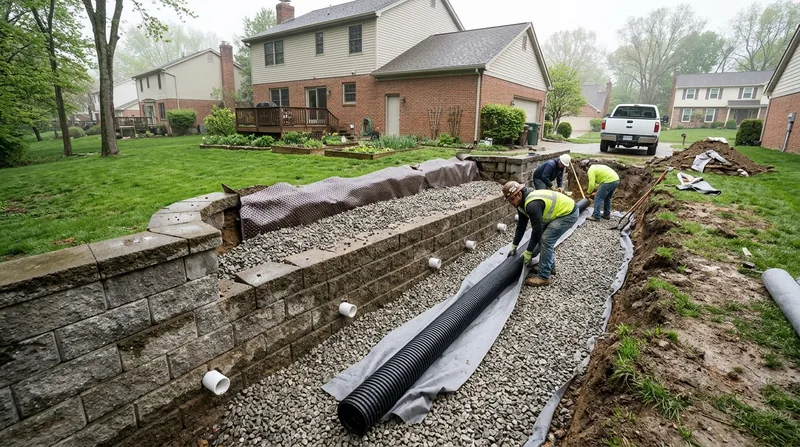




Columbus sits on dense, slow-draining glacial clay till, and that geology is the enemy of retaining walls. Spring rains soak into the soil behind your wall, freeze-thaw cycles crack the structure, and hydrostatic pressure pushes it out of line or collapses it entirely. Retaining wall drainage in Columbus is not optional, it is survival. Whether your wall is stacked Ohio limestone in German Village, segmental block in a newer subdivision near Dublin, or tired railroad tie terracing from the 1970s, proper drainage stops water from destroying the structure from behind. We install French drains, weep holes, gravel backfill, and filter fabric that move water away fast, relieving the pressure that causes most wall failures in this region. The cost starts low, the payoff is a wall that lasts decades, and the alternative is a collapsed wall and a much bigger bill.
Why Retaining Wall Drainage Fails in Columbus' Clay and Freeze-Thaw Climate
Columbus homeowners face a perfect storm of drainage failure: clay-heavy soil that sheds water slowly, brutal freeze-thaw cycles from November through March, and spring rains that saturate the ground behind retaining walls. Water trapped behind a wall exerts enormous hydrostatic pressure, especially when it freezes and expands. Walls without proper drainage tilt forward, crack, or fail completely. This is not a cosmetic issue, it is structural failure that can damage your property, your driveway, or your home's foundation.
- Water pressure behind an undrained wall can exceed 1,000 pounds per linear foot, pushing stone, block, or concrete forward.
- Frost heave in Columbus clay lifts and shifts walls upward, breaking mortar joints and creating gaps where more water enters.
- Saturated soil behind a wall adds weight and destabilizes the base, causing tilt and settlement.
- Weep holes and French drains prevent water accumulation and reduce the pressure that drives failure.
Drainage work done right keeps water moving away from the wall structure, protecting your investment and your property.
Key info: In Upper Arlington and Worthington, where ravine lots and steep grades are common, walls without drainage fail within 5 to 10 years. Homes in German Village and Victorian Village with 1800s limestone walls often show signs of water damage and bulging after decades without maintenance. Drainage repair stops the clock and restores stability.
For detailed guidance on wall failure and repair options, see our leaning and collapsed wall repair service.
The City of Columbus Building and Zoning Department provides guidance on wall permits and setback rules; verify requirements with your local jurisdiction before work begins.
How We Install Retaining Wall Drainage in Columbus: Step by Step
Drainage installation starts with understanding the wall, the soil, and the water flow. We dig behind or around the wall, install gravel and filter fabric to move water horizontally, and place perforated drain pipe to carry it away safely. The work is methodical and often requires careful excavation near existing structures, driveways, or utilities. Every job is different, but the principle is the same: intercept water before it reaches the wall.
- We assess the wall, soil type, and existing water flow to determine the best drainage strategy.
- We excavate behind the wall or install a trench along the base, taking care to avoid damage to nearby structures.
- We lay landscape filter fabric to prevent soil from clogging the gravel and drain pipe.
- We place perforated drain pipe (typically 4-inch PVC or HDPE) at the base or mid-height of the wall.
- We backfill with gravel around the pipe and fabric to allow water to flow freely into the drain.
- We run the drain line to daylight or to a catch basin, so water exits away from the wall and property.
This process removes water that would otherwise saturate the soil and destroy the wall from behind.
Local example: A homeowner in Gahanna had a 6-foot block retaining wall holding back a slope behind her driveway. After two winters, water was pooling at the base and the wall was tilting inward. We installed a French drain with a 4-inch perforated pipe, filter fabric, and gravel backfill. The drain runs to a daylight outlet 40 feet downslope. Cost was $4,200. The wall is now stable and dry, and the driveway no longer shows settlement cracks.
For new wall installation with proper drainage built in from the start, see our retaining wall installation service.
Drainage Methods and Approaches for Columbus Retaining Walls
| Approach | Description | Best for |
|---|---|---|
| French Drain with Perforated Pipe | A trench filled with gravel and a 4-inch perforated drain pipe that collects water and carries it away to daylight or a catch basin. | Most retaining walls in Columbus, especially those with high water tables or saturated clay soils. |
| Weep Holes and Gravel Backfill | Small openings drilled or formed in the wall face, with gravel and filter fabric behind the wall to allow water to exit safely. | Existing walls where major excavation is not feasible, or walls with limited space for a full French drain. |
| Toe Drain at Wall Base | A perforated pipe installed at the very bottom of the wall, in the footing trench, to intercept and divert water before it accumulates. | New walls or walls being rebuilt, where the base can be accessed and the drainage system designed into the structure. |
| Surface Grading and Slope Diversion | Regrading the surface behind and around the wall to direct water away from the wall face, combined with swales or channels. | Walls with poor surface drainage or where water is flowing directly toward the wall from upslope terrain. |
| Filter Fabric and Aggregate Replacement | Removing failed or clogged backfill and replacing it with new gravel and landscape fabric to restore water permeability. | Older walls where the original backfill has become compacted, silted, or contaminated with clay. |
The right approach depends on your wall type, soil conditions, and access. We evaluate each site and recommend the most cost-effective and durable solution.
Retaining Wall Drainage Cost in Columbus: What to Expect
Retaining wall drainage work in Columbus typically starts at $2,500 for a basic French drain installation on a wall 20 to 30 feet long. Costs rise with wall length, soil conditions, access difficulty, and the need to route water a long distance to daylight. A 50-foot wall with deep excavation and a long drain run can easily reach $6,000 to $8,000. Emergency repairs to a failed or collapsing wall are higher. The key factors affecting your quote are wall length, soil type (clay is harder to dig and slower to drain), proximity to structures or utilities, and whether the drain must run uphill or downhill to exit.
We always recommend getting 2 to 3 estimates from licensed contractors. Cheap quotes often mean shortcuts, poor-quality pipe, or inadequate filter fabric. A properly installed French drain will last 20 to 30 years and prevent wall failure. A poorly installed drain will fail within a few years and cost you twice as much to fix. For a detailed pricing breakdown and to understand what moves the cost up or down, see our full pricing page.
Call us for a free, no-obligation estimate. We respond within 24 hours and explain exactly what your wall needs and what it will cost.
Retaining Wall Drainage Near Me: What to Look for When Hiring a Contractor in Columbus
Not every contractor who can build a wall can properly install drainage. Drainage work requires understanding soil mechanics, water flow, and long-term durability. When you call a contractor, ask whether they are licensed and insured, how many drainage jobs they have completed in Columbus clay, and whether they can show you references. Get at least two estimates, and do not choose based on price alone. The cheapest job often becomes the most expensive repair.
Check that the contractor is licensed and insured for retaining wall work in Ohio. Confirm that they understand Columbus building codes and permitting requirements for walls above 4 feet or walls that support a surcharge like a driveway. Ask about their warranty on the drainage system and get it in writing. If your wall is part of an HOA property, verify that the contractor understands any HOA rules or approval requirements. Always verify permit thresholds with your local building department before work begins, as rules vary by city.
Contact us today to schedule your consultation.
Retaining Wall Drainage in Columbus: Pricing Guide
| Service | Price | Details |
|---|---|---|
| French Drain Installation (20-30 feet of wall) | Starting at $2,500 | Includes perforated pipe, filter fabric, gravel backfill, and drainage to daylight or catch basin |
| Weep Hole and Backfill Restoration | Starting at $1,800 | Drilling weep holes, installing filter fabric, and replacing gravel backfill on existing walls |
| Extended French Drain (50+ feet) or Complex Routing | Starting at $5,500 | Longer wall length, difficult access, poor soil conditions, or drain line must run uphill to daylight |
| Emergency Drainage Repair (Saturated or Failing Wall) | On estimate | Urgent work on actively failing walls requires site inspection to assess damage and determine scope |
| Travel and Site Visit | Included | No separate charge for travel within Columbus and surrounding service areas, included in estimate |
| Free Estimate | No charge | Response within 24 hours at (380) 800-5656, walk the site, explain the problem and the solution |
Indicative pricing, the exact cost depends on square footage, finish, and site access. Free personalized estimate within 24h at (380) 800-5656.


